
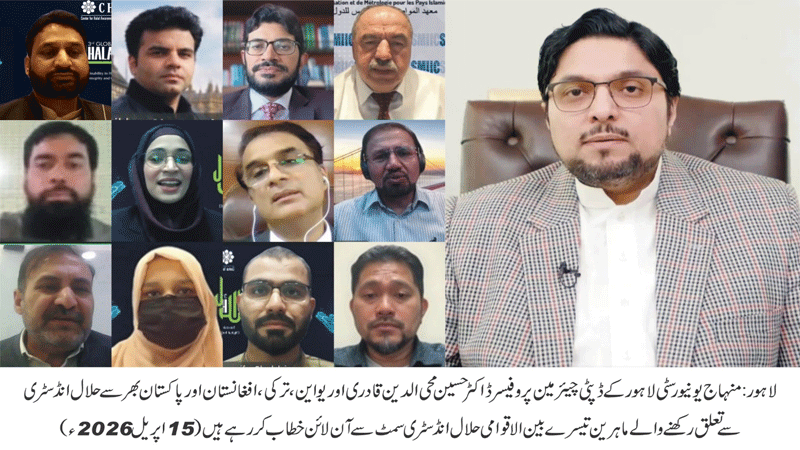
- The Halal Authority Bill was passed in 2016, but consultations have been ongoing for the past ten years on which authority it should come under.
- The halal industry, growing at an annual rate of 9.1%, is projected to reach a financial volume of $6 trillion by 2034.
- Pakistan’s annual halal exports stand at $512 million, while a non-Muslim country like Brazil earns $6 billion annually.
- The concept of halal and hygienic (pure) products was introduced to the world by Islam, yet Muslim countries have fallen behind in this sector.
- These remarks were made by Professor Dr. Hussain Qadri while addressing the third Global Halal Industry Summit organized by Minhaj University Lahore
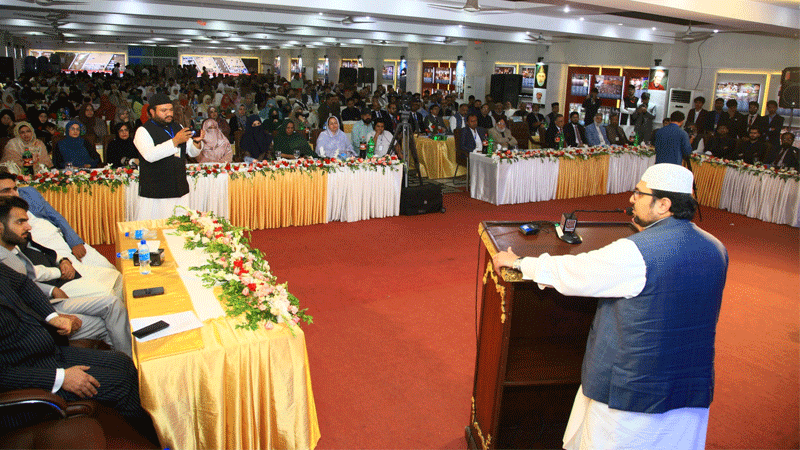
The third Global Halal Industry Summit was organized by the Center for Halal Awareness, Research and Training (CHART) at Minhaj University Lahore, bringing together national and international experts, policymakers, and stakeholders from the halal industry.
The summit was organized under the leadership of Professor Dr. Khurram Shahzad (Registrar, Minhaj University and Director CHART) and Dr. Munir Hussain (Deputy Director CHART). Supporting institutions included Nizam-ul-Madaris Pakistan, the School of Pharmacy, Minhaj Halal Certification (MHC), the School of Food Science and Technology, the School of Human Nutrition and Dietetics, and the College of Shariah and Islamic Sciences.
Addressing the summit, Deputy Chairman of Minhaj University Lahore, Professor Dr. Hussain Mohi-ud-Din Qadri, presented a research paper stating that Pakistan’s share in the $2.5 trillion global halal economy is only $512 million in exports, while a non-Muslim country like Brazil earns $6 billion annually from halal exports.
He highlighted that the global halal economy, currently valued at $2.5 trillion, is projected to reach $6 trillion by 2034, growing at an annual rate of 9.1%—a pace that outstrips many other industries. He emphasized that establishing an autonomous halal authority in Pakistan is indispensable to fully benefit from this rapidly expanding market.
Dr. Hussain Qadri noted that although the Halal Authority Bill was passed in 2016, consultations have continued for a decade regarding which administrative body the authority should fall under. He pointed out that bureaucratic hurdles—such as the need for approvals from multiple ministries—have hindered the growth of Pakistan’s halal industry. Removing these barriers through an independent authority is crucial.
He further observed that while the concept of halal and hygienic products originates from Islamic principles, Muslim countries have fallen behind in capitalizing on it. In contrast, countries like Malaysia, Singapore, Saudi Arabia, and the United Arab Emirates are leveraging blockchain and artificial intelligence for halal certification and supply chain management.
Highlighting Pakistan’s potential, he stated that the country has the world’s second-largest Muslim population (over 240 million), the fifth-largest livestock population globally, including more than 100 million cattle and buffaloes and over 117 million sheep and goats. With over 60% of its population comprising youth, vast fertile lands, and natural pastures producing high-quality meat, Pakistan is strategically positioned as a bridge connecting Central Asia, the Middle East, and South Asia, with strong land and sea transport routes.
The summit was moderated by Huzaifa Shabbir, Tooba Khanum, and Areeba Muzaffar.
Distinguished international delegates included Ihsan Oot (Turkey), Muhammad Fauzi Abu Hussin (Malaysia), and James Robert Okaat (United Nations). Speakers stressed the need to modernize the global halal supply chain through smart technologies, blockchain, and sustainable logistics.
At the national level, speakers included Dr. Yasir Saleem, Dr. Muhammad Shoaib, Director General Food Punjab Muhammad Asim Javed, and Atiq ur Rehman Memon from the Pakistan National Accreditation Council. They highlighted opportunities to promote Pakistani products in global markets through green innovation, circular economy practices, and international accreditation in halal manufacturing.
A key panel discussion was also held during the summit, where experts deliberated on industrial digitalization, supply chain transparency, and sustainable production systems.
In his closing remarks, Deputy Director CHART Dr. Munir Hussain thanked participants, international delegates, and partner organizations, reaffirming the commitment to continue advancing research, training, and innovation in the halal industry.





Comment